Tele-Films

Mr. Khan’s Review on Behadd (2013)

A review on Pakistani telefilm Drama, Behadd (2013). The TV film is a directorial debut by Asim Raza and is written by the Urdu novelist Umera Ahmad. The film stars Nadia Jamil, Fawad Khan and the young Sajjal Ali. This telefilm is produced by Momina Duraid and is a HUM TV production.

+ Crew

  • Directed by Asim Raza
  • Written by Umera Ahmad
  • Edited by Kashif Ahmad and Wasim
  • DOP by Suleman Razzaq
  • Theme music by Fawad Khan
  • Music Composed by Hasil Qureshi
  • Produced by Momina Duraid

+ Note

The famous commercial TV director/ producer Asim Raza announced to the press beforehand that Behadd is going to be his directorial debut in the world of telefilms. As many of Umera Ahmad’s screenplays, Behadd serves also as a ‘slice of life’ tale and explores the relationship between a widowed mother and her young teenage daughter. The telefilm indulges in themes such as single parenthood and ‘selflessness’ verses ‘selfishness’. How important is one’s own happiness as compared to your child’s. 

The film was primarily shot in Karachi, Sindh and used real locations and settings of the city. After its release, Behadd received praise from critics and viewers alike and was the recipient of Hum Awards for Best Producer in 2014.

 + Main Cast

  1. Fawad Khan as Jamal “Jo” Ahmed
  2. Nadia Jamil as Masooma “Mo” Jamal
  3. Sajal Ali as Maha
  4. Nadia Afgan as Shafaq
  5. Nasheen Masud as Popi “Po” Masood
  6. Rahma Saleem as Fareena

 + Supporting Cast

  1. Adnan Siddiqui as Hassan (Masooma’s husband)
  2. Adnan Jaffar as Shafaq’s husband
  3. Shamoon Abbasi as Masooma’s boss
  4. Hira Tareen as Shaista (Jo’s proposal)

+ Plot

After the unfortunate death of her husband, Masooma (Nadia Jamil) is left to take care of their daughter Maha (Sajal Ali) all on her own. Along her journey to single parenthood, Masooma ends up meeting her old friend’s brother Jamal (Fawad Khan) and they both quickly realize that they have much more in common than they could ever hope for. 

+ High Points

i – Behadd’s ‘slice of Life’ plot is what makes most Pakistani Television so appealing to watch. With Umera Ahmad’s impeccable writing and Asim Raza’s meticulous direction, the telefilm works pretty much on every facet of successful storytelling. Even if you have never had a child or been a single parent, Behadd just feels so magnificently real and relatable. 

“If you indeed have to be selfless, how far can you take it?”

“What if your selflessness and wellbeing is being detrimental to those around? Should you then focus on your own happiness?” 

These are incredibly valid questions that we, in our line of duty of being a parent, tend to forget. 

ii – Brilliant performances all around but what stands tall above the rest is Nadia Jamil’s depiction as an overzealous single parent. Her reading of dialogue and body language conveys greatly her anguish and suffering behind the facade of being strong for her daughter.

iii – Some of the best scenes came not only from the climactic scenes of the telefilm but also the much quieter moments when Masooma is just casually interacting with her friends and colleagues in the office. The nonchalant manner of speech and dialogue is so crucial in inviting the audience to become part of the scene itself and Behadd’s writing and supporting cast exactly does that.

iv – And of course, the breakout performance by Sajal Ali as Maha was also a valiant effort in making this telefilm a success. Her performance was essential in order to captivate the audience into buying into this tale of mother/ daughter relationship. 

v– Behadd is a perfect example of why a show/ telefilm doesn’t need overbearing music and editing to force the audience into feeling sympathy with the characters. The writing and performances have to be good enough to invite their audience into that. Never did my attention falter or felt manipulated in any way. And that’s a sign of pure class from the creative team behind this telefilm.

vi– The song “Nindiya Re” by Kaavish is how seemlessly music and visuals can create the perfect rhythm. Perfect selection for Behadd’s OST.

vii– The conclusion of the story was also brilliantly handled and executed. Considering the circumstances of the storyline, this was probably the most logical conclusion that could have occured. Kudos to the entire team behind this telefilm!

 + Low Points

i – Honestly, whatever low points I have are mostly nitpicks but are still issues with the telefilm’s onset production. Namely, the overuse of Close Ups. Now close ups can be very impactful in visual language but only if they are used sparingly. Behadd unfortunately indulges in it a tad bit too much and it does lose its impact after a while. 

ii – And speaking of close ups, the cinematography is also nothing to admire at. Although it’s fairly competent by Suleman Razzaq, he did not use the visual language to its full potential and now just comes off sub par in contrast to the brilliant writing and performances of the telefilm.

iii – As much as I adore Behadd, it also suffers from the “rich people with rich people problems” syndrome. Now being wealthy does not equate to happiness, that’s fairly obvious but almost all Pakistani dramas/ telefilms shoot in lavious, massive houses so that they visually look pleasing to the eye and almost never a decision made based on the script. But have to give credit to Behadd as they did explain that they are living in the house as tenants. 

+ Overall

A well written script, brilliant performances, no overbearing use of music/ dramatic effects, Behadd is what every Pakistani telefilm should strive to be.  

Rate: 4.25 out of 5 stars
Tele-Films

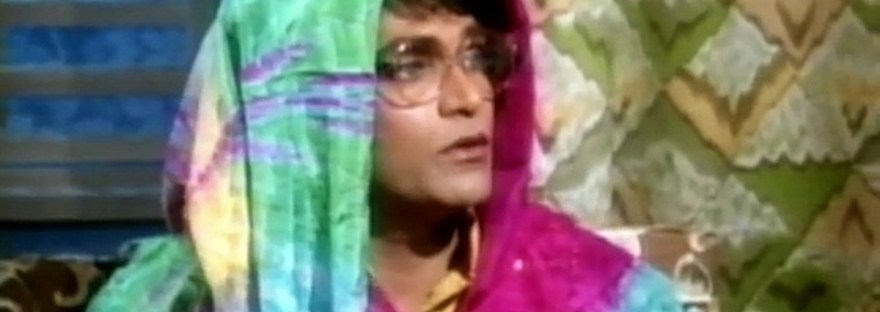
Mr. Khan’s Review on Rozi (1990)

A review on Pakistani telefilm, Rozi (1990). The telefilm is directed by Sahira Kazmi and stars the legendary Moin Akhtar in one of his most iconic roles of his career. Rozi is an Urdu adaptation of Dustin Hoffman’s classic Tootsie (1982). Rozi is a ‘Tele Theater’ Production. 

+ Crew

  • Directed by Sahira Kazmi
  • Written by Imran Saleem
  • DOP by Aem Nawaz, Jameel Akhtar and Arif Saheel
  • Make up by Shamina Kaisar
  • Editing by Ahfaq Ahmed

+ Note

Before we proceed any further, let us first discuss the Elephant in the room. Rozi is now cited as an “Urdu adaptation” of the Hollywood classic Tootsie (1982) starring Dustin Hoffman. But it has been clearly not credited anywhere in the End credits of the telefilm and I severely doubt if the producers took the permission from Columbia Pictures to adapt Tootsie into a Pakistani telefilm. As a reviewer and fan of the original film, it makes it harder for me to judge Rozi based on its own writing merit since every scene and dialogue has been directly lifted from the Hollywood classic. But for the sake of the review, I will judge the telefilm on its own achievements here on out and analyse what the Pakistani creative team managed to accomplish on its own. 

Apart from the controversy, Rozi was clearly a role tailor made for the talents that Moin Akhtar possessed and unsurprisingly, Rozi elevated Akhtar to stardom and proved to be one of his personal favorite roles of his career.

 + Main Cast

  1. Moin Akhtar as Haroon/Rozi
  2. Fazela Qazi as Nazia
  3. Akbar Subhani as Rashid
  4. Fariha Altaf as Sahana

+ Plot

Haroon (Moin Akhtar) is a down on his luck actor who is sick and tired of the Pakistani TV industry and its lack of originality. Therefore, Haroon disguises himself as a woman Rozi in order to land a role in a major TV soap opera. Along the way, Haroon falls in love with Nazia (Fazela Qazi) and realizes what difficulties a woman has to face in the world of Television.

+ High Points

i – As far as adaptations go, Rozi has very seamlessly been adapted from an American setting into Pakistani culture and Urdu dialogue by Imran Saleem. 

ii – There was arguably no one in Pakistani Industry at the time who could have played the role of Rozi other than the legendary Moin Akhtar. Since the character within the story is a disguise, Moin Akhtar had the monumental task of playing two fictional characters within one narrative; Haroon and Rozi and its safe to say that Akhtar played it off with such flair and tenacity that leaves viewer not only charmed by his performance but are right alongside him throughout the narrative. Rozi might arguably be the pinnacle of Moin Akthar’s career in Television. 

iii – Speaking of role models, Rozi speaks to many female actors how hard it is for them to be recognized for their talent and not brushed aside once they reach a certain age. Although the character of Rozi is fictional, her plight for self-respect and recognition is very much real. And just for that, this telefilm was incredibly groundbreaking in Pakistan for its time.

iv – Rozi is full of excellent performances. And although Moin Akthar undoubtedly takes the center stage, Fariha Altaf as Sahana is clearly the highlight of the film. Her desperation and anger plays hilariously to the comedy of errors that Haroon has concocted in order to salvage his acting career. Whenever these two were on screen together, you know there will be laugh out loud moments.

v – Comedy is all about timing. And Rozi nails it with such impeccable precision that even after 30 years, Imran Saleem’s writing has still lost none of its charm. 

vi – The makeup of Rozi is not the most believable out there but honestly, it never needed to be. The wig, fake eyelashes, lip stick work are sufficient enough to make the viewer buy into the fact that most characters would not be able to recognize Haroon in disguise. And I am completely onboard with some ‘suspension of disbelief’ in order to enjoy the story.

vii – The scenes between Rozi and Nazia’s father are hilarious and they play fantastically off one another.

viii – The ending of Rozi will leave a warm, fuzzy feeling inside you long after you are done watching it. It’s the perfect ending you could have to the story.

 + Low Points

i – Rozi consists of such a talented team of writers, actors, producers which makes it so frustrating to see that they “adapted” every scene, every dialogue from the film Tootsie. With all this effort, why could they have not just taken the premise of Tootsie and wrote original scenes and situational comedy around it? If you have already seen the Hollywood film, It is so utterly frustrating to know what is going to come next. In Urdu, one says:

“Nakal ke liye Akaal ki bhi zaroorat parhti hai!”

(To plagiarize, one still needs the smarts to pull it off!)

But why not just use the “smarts” to write something original instead?   

ii – The telefilm sadly feels incredibly low budget and cheap. The set design looks exceptionally dull and uninspiring. It’s obvious that absolutely no location scouting was done prior to the production of the telefilm. The team just arrived on location and had to shoot X number of scenes for the day. This approach unfortunately does no favours to all the hard work that the actors put into each scene.

iii – Director of Photography is pretty much non-existent. There is absolutely no skill involved. The lack of proper framing a shot, not bothering to set proper light exposure, the camera moves arbitrarily as it please, regardless if the scene requires it or not; the only successful task they managed to accomplish was press the ‘rec’ button on the camera.

iv – The production quality (for lack of a better word) sucks. Visually, the telefilm is hideous (and I’m not talking about the VHS quality of it which is currently uploaded online). I know I should go easy on it since it’s 30 years old but Tele dramas before Rozi have accomplished so much more so there clearly is no excuse for it.

v – The editing is god awful. The telefilm (or tele theater) has two minds whether to edit it like a theater play or a telefilm. And it fails on both aspects. It’s lethargic and sometimes lingers far too long on one shot. Did the editor fall asleep while working mid scene? 

+ Overall

Even after 30 years, Rozi is fondly remembered due to its stellar performances and comedic writing but the lack of proper production makes it at times hard to watch. But just for Moin Akthar’s iconic performance alone, Rozi is worth a go.

 Rate: 3.0 out of 5 stars

Tele-Films

Mr. Khan’s Review on ‘Thanda Garam: Eik Saath’ (2016)

A review on a Pakistani Comic thesis film, ‘Thanda Garam: Eik Saath’ (2016). The Production Company is SZABIST (students film production) while its Distributor is Rivayat Pictures.


+ Crew
I. Editing, Written, Directed & Produced by Mirza Shuja Uddin Beg
II. Cinematography by Affan Ahmed Khan
III. Sound Mixing and Makeup & Hair Styling by Altamash Ali Banani
IV. Co-Sound Mixing & Co-Edited by Rahim Aziz Sajwani


+ Note
Thanda Garam is a hilarious farce film where wrong people at wrong time are present in one house. A similar type of technique is famously used in the classic comedy film ‘Boeing, Boeing’ (1965) of Tony Curtis & Jerry Lewis. This thesis adviser is Zeeshan Haider while its Assistant Director is Amna Tariq and the 1st Unit Director is Sumair.


+ Cast
1. Kaleem Ghouri as Khumaar
2. Saad Zameer Fareedi as Bhala Bhai
3. Shabana Hassan as Laila/Laiba
4. Jahan Zaib Naviwala as Hijir
5. Zeeshan Ahmed Khan as (Voice Cameo)


+ Plot
In a very difficult situation, Khumaar has able to convince his love interest Laila to meet him at his home all alone to spend some ‘Special’ time together. But due to sudden unfortunate events, his close friend Hijr forcefully enters his home as he needs an urgent quick shower to get ready and reach to a ceremony (Valima) where Hijr’s crush is also coming. While all this is going on, Khumaar’s neighbor Bhala Bhai also drops by and insists to watch his favorite drama series on Khumaar’s TV since his own TV is not working.


+ High Points
i. First & foremost the script which is written by the director. In many places he could had used open sexual reference-based jokes which he did not but rather used a more double / hidden meaning. Nowhere would I say that the jokes were vulgar or should not to be watched by mass audience.

ii. Saad Zameer Fareedi, {Wa Puthr! Tu To Cha Gaya} means this actor performed so brilliantly and intelligently that I would personally recommend him to any TV or Film Maker out there. This guy is the ‘Real Deal’, interesting to watch whenever his scenes were shown in the film. The director told me that he barely discussed with Saad what to do according to his character wants. He further added that the actor himself is so well trained and naturally talented that Saad knew exactly how to deliver the essential acting chops in able to gain audience attention towards him. Whenever Saad entered the frame as Bhala Bhai, the audience had huge smiles on their faces.

iii. It was a real challenge for the director that how he would be able to pull this off without raising his film ratings for targeted audience. At best I could say its a PG-13 film. Anyone who watches this film, would highly praise on its script analysis and in directorial POV that is how to keep the audience engaged throughout the film.

Mostly people, amateur film makers think or belief that its easy to make people laugh which in reality its not! Poor comedy films would usually use the help of random abusive remarks, stereo types, unrelated fight scenes, toilet or open sexual humor to make the film look like a good comedy film. In this film however, the sexual humor is carefully controlled by the director and not to present in open or explicit manner.

iv. Shabana Hassan really nails her character. She is a good experienced actress in theatre plays and films. Here the kind of love interest that she was told to perform, she did it with such enthusiasm that it was clearly shown on screen. The chemistry between Kaleem & her is comical and fun to watch.


+ Low Points
i. The art direction and the location (house) that the BTS team used to shoot worked against the main character’s status and personality.

ii. I do not agree with the director’s view on the film’s end, how he finishes it off. I believe it could have been better, brighter as almost the entire film was based on.

iii. The color correction in some scenes did not fit in properly. The transfer of the next scenes could have improved, sharper cuts.

iv. There were several movie mistakes in the film such as in one scene Bhala Bhai is standing next to the room’s door telling Khumar go and talk to Hijr in the lounge and in the very next scene, we see that Bhala Bhai is already sitting in the lounge where Khumar is talking with his friend Hijr.


+ Overall
Where many new film makers have failed to come up with genuine, creative jokes, it is Thanda Garam who has succeeded.


Rate: 4.0 out of 5.0 stars

Tele-Films

Mr. Khan’s Review on ‘Vicky’ (2016)

A review on Pakistani TV film, ‘Vicky’ (2016); Associate Produced by Zoobia Anwar and Onaissa Rizwani.

 
+ Crew
I. Directed & Executive Produced by Taha Bin Karim
II. Cinematography by Shajee Hasan
III. Written by Ali Abbas Naqvi & Ziad Azad
IV. Music by Zahid Qureshi
V. Edited by Saad Abbas
VI. Produced by Shahriyar Ali Soomro


+Note
There are several minor supporting roles while some of them played by Zeeshan Haider (thesis advisor), Sameena Nazir and Aamir Naqvi. Its Assistant Directors are Zoobia Anwar, Ali Raza Soomro & Mustafain Haider while it’s Production Designer is Ali Raza Soomro.


+ Main Cast

  1. Nazr Ul Hasan as Yaqoob Sergeant
  2. Muhammad Ahsan as Vicky
  3. Shabana Hasan as Bela
  4. Shajee Hasan as Anjum
  5. Anas Yasin as Saim


+ Plot
It is about Vicky, a hot-headed young lad who is troubled by his poor relationship with his brother and due to lack of resources. The only thing he has with him is Bela, who is the light of his dull life. However nothing remains the same as Bela chooses a ‘Comfortable’ life over him.


+ High Points
i – Nazar-ul-Hasan played the role of Yaqoob very well. It terrified the audience with his devilish stare, his evil behavior with his ‘Loved Ones’ and use of his illegal authority during the day time as traffic police officer. Other Honorable Mentions: Muhammad Ahsan, Shajee Hasan and Shabana Hasan.

ii – The story was appealing to watch.

iii – The characters of Yaqoob and Vicky were well written.

iv – The art direction and locations were well chosen.

v – The cinematography especially of the bold scenes was executed cleverly.

vi – The screenplay is adequately written.

vii – The direction is above average.

viii – The ending has a good twist.


+ Low Points
i – Except for one character, there is absolutely no character shift of anyone else in the film.

ii – The clichés could had been avoided regarding Vicky and Bela’s romantic sea view scenes and Bela’s mom not listening to her daughter. This is an overused technique and shots that been taken by usually young, inexperienced film makers.

iii – Anjum’s character seemed very interesting. Unfortunately, we didn’t see much of his character development.

iv – The suffering of the victim/s were rarely shown. Their continuous struggle would have made a great impact on the characters and viewers alike.

v – Yaqoob’s voice seemed unnatural to the character that Nazar-ul-Hasan played.

vi – It was shocking to see that how causally Vicky especially Bela took the fact that now since Vicky is here, she should apply some makeup or make tea before leaving the house of the RAPIST! WTH! Are you serious?

vii – Throughout the film, there were several shock treatments while many plot holes were left unanswered. Such as did the neighbors do something about of the Yaqoob’s activities? Were the Yaqoob’s activities happening inside his house were ever discovered? Did Bela’s parents ever found out of her condition in groom’s house? Did Vicky ever find good, steady life? Did Bela ever confront her ‘To Be’ husband? Did the police ever catch Vicky?

viii – Is it possible to someone to get married without even once checking out the groom’s home or do some research before giving away your daughter just like that to groom’s family? It’s not like the girl was disfigured nor had lack of wedding proposals? The certain time period which takes place between during the days of marriage but here everything happened so quickly, as if only needed approval for court marriage certificate.

ix – When Vicky is told from what address he could pick his bike from whose house, at that time he would surely know who Yaqoob really is. But no acknowledgement is shown on Vicky’s face. It means either Vicky already knew who Yaqoob is and this was a movie mistake or it was intentionally kept that way and let the ending reveal it on its own.


+ Overall
Finding the emotional story within the drama, director Taha Bin Karim, enigmatic Nazar-ul-Hasan and intriguing Muhammad Ahsan craft brings a satisfying bitter twist to Vicky.

 
Rate: 3.0 out of 5 stars

Tele-Films

Mr. Khan’s Review on ‘Haraami’ (2017)

A review on Pakistani Tele film, ‘Haraami’ (2017); Assistant Cinematography & Editing by Affan Ahmed Khan, Assistant Directed by Ahmer Hussain while its Production House is AAL Films.

+ Crew
I. Directed, Screenplay & Produced by Ali Akbar Ladhani
II. Cinematography by Inzamam Jalal
III. Co-Screenplay by Ahmer Hussain
IV. Production Design by Saad Abbas
V. Makeup & Costumes by Pervaiz Iqbal


+Note
The film is inspired by infamous English film ‘I Spit on Your Grave’ (1978) & remake in 2010. It is a rape & revenge exploitation-horror film, shot with shock treatment. There are several minor supporting roles including Rashid Farooqui, Akbar Islam, Sahrosh Baloch and Mahjabeen. Its Music Composer is Asif Noorani and its Sound Mixer is Zeeshan Ali.


+ Main Cast

  1. Ahmer Hussain as Sufian
  2. Nazar Ul Hasan as Ms. Shaukat
  3. Arshad Malik as Jamshed
  4. Aqeel Ahmed as Affan
  5. Adnan Anis as Fahad


xxxxxx


+ Supporting Cast

  1. Kaleem Ghouri as Police Officer
  2. Naveed Mari as Police SHO
  3. Kulsoom Aftab as NGO Director
  4. Erum Bashir as Anum

+ Plot
Due to Sufian’s secret dark activity, his loved one has to pay the ultimate price for it.

+ High Points

i – Nazar-ul-Hasan played the role of transgender sex worker who played out very nicely. He was the key figure in this film. Other Honorable Mentions: Adnan Anis.
ii – Some of the visuals inserts regarding city’s scenery are well shot.

iii – The shock treatment used with Arshad Malik was very bold indeed.
iv – The art direction is satisfactory.


+ Low Points
i – Too many cast members hired from NAPA including its location been used did not gave a professional but rather a student film look.
ii – There was hardly any character development.
iii – The cinematography is disappointing.
iv – The story & screenplay is so-so written.
v – Nazar’s character seemed very interesting. Unfortunately, we didn’t see much of his character backstory either.
vi – The twists & turns were too predictable.

+ Overall
A glossy, tasteless revenge thriller that brings out fragile performances despite being boldly shot on a taboo subject.

Rate: 1.0 out of 5 stars