TV series

Mr. Khan’s Review on Mann Ke Moti (2013 – 14)

A review on Pakistani TV Drama Series, Mann Ke Moti (2013 – 14) aka Qismet Ke Khial. Its Production House is A & B Productions while its Distributor is Geo Entertainment.


+ Crew

  • Directed by Nadeem Siddique & Ali Faizan
  • Written by Kifayat Rodini
  • Director of Photography by Saleem Abbas, Rehan Mirza & Adnan Bukhari
  • Score by Mohsin Allahditta
  • Produced by Asif Raza Mir and Babar Javed


+ Note
Mann Ke Moti aired on Geo Entertainment from 23rd Feb 2013 – 7th Dec 2014. In total it consists of 62 episodes (1 – 2 Seasons). Its associate director is Hassan Qureshi and assistant director is Azam Khan. The editing is done by Kashif Ahmed and its production design by Waqas Hassan Rizvi.

Nadeem Siddique directed the 1st Season while the 2nd Season was directed by Ali Faizan. In India, this drama series is known as ‘Qismet Ke Khial’.

This review may carry SPOILERS!


+ Main Cast

  1. Faisal Qureshi as Raheel
  2. Yasra Rizvi as Fariha
  3. Zuhab Khan as Guddu / Bablo
  4. Fiza Arif as Hina (Young)
  5. Sonia Kazmi as Falak (Young)
  6. Asma Abbas as Nasreen / Raheel’s Mother
  7. Waseem Abbas as Farhan
  8. Suddu Ali as Daniyal (Young)


xxxxxxx


+ Supportive Cast

  1. Sundas Tariq as Zara / Raheel’s Sister #1
  2. Minza Waqas as Maham / Raheel’s Sister #2
  3. Suhaee Abro as Hina (Adult)
  4. Faizan Khajawa as Daniyal (Adult)
  5. Mona Shah as Falak (Adult)
  6. Ali Sheikh as Sagheer / Falak’s Boyfriend
  7. Arisha Razi as Munni
  8. Arjumand Rahim as Bablo’s Mother


 xxxxxxx


+ Other Cast

  1. Aiman Khan as Sehrish / Maham’s Sister-in-Law #1
  2. Minal Khan as Kaavish / Maham’s Sister-in-Law #2
  3. Faizan Shaikh as Asfaq / Maham’s Husband
  4. Fareeha Jabeen as Maham’s Mother-in-law
  5. Sohail Khan as Maham’s Father-in-law
  6. Omer Shahzad as Zara’s Husband
  7. N/A as Nida / Falak’s Friend
  8. Malik Raza as Garbage Collector (Cameo)
  9. Salahuddin Tunio as Sagheer’s Father


+ Plot

Raheel feels it’s necessary for him to go abroad for work to earn a better living for his family. Although his family, including his mother is against to such decision as they would be alone without his presence. Soon, bad luck is struck upon Raheel’s family where they need to survive on their limited resources.


+ High Points

i – Zuhab Khan gave a superb performance as loud mouth, short temper son / brother as Guddu / Bablo who speaks out bluntly but is good at heart. It is rare to see such performance by a child star. Other Honorable Mentions: Yasra Rizvi, Asma Abbas, Faisal Qureshi, Waseem Abbas, Aiman & Minal Khan and Faizan Khajawa.

ii – The hardships to show how the family has to struggle in absence of Raheel and how their most closest ones starts to reject them from their lives is very realistically been shown to the audience.

iii – Though the performances by the entire cast is good but the child stars especially have done a fantastic job, such as Sonia Kazmi, Fiza Arif and Suddu Ali.

iv – It is interesting to watch as the story continues to progress without the lead actor; how Raheel’s family suffer mainly the children, is heart breaking to watch. It reminded me of the fame Bengal film, Pather Panchali (1955).

v – A sensitive, uncalled love relationship is shown of Hina & Daniyal and how the both families have to deal this situation including consulting the religious law over it.

vi – The direction of the 1st season by Nadeem Siddique is praise worthy. The collaboration with the writer, Kifayat Rodani has helped Nadeem to direct the first season is very intriguing manner.


+ Low Points

i – Wait, hold on a second… you are telling me that Raheel’s both sisters are now living elsewhere (one is in Islamabad and other in Dubai) therefore it’s okay that they are not informed of their mother’s near death condition including falling in coma for such a long time and Raheel’s 12 years of absence return. What?!

ii – An embarrassing end to this ‘Once a Great’ TV drama series. This would happen only when one cannot take ‘No’ for an answer. Instead of having respectable, decent end which you did had in 44th episode. And yet, why go for the second season (45 – 62 episodes) came from the depths of hell which was highly unnecessary to show and the inclusion of mumbo, jumbo ‘Black Magic Baba’ with a tongue-in-cheek to watch and eventually make fun of yourself as to why watched this TV series in the first place for.

Mann K Moti’s 2nd season and its end, strongly reminded me of infamous TV series Mann Mayal (2016); a very similar ending to watch in it too.

iii – I am not sure if Arjumand Rahim was the best option to play Bablo’s mother. Same thing I would say for Fareeha Jabeen in a mother’s role. They both are best suitable for negative roles only. Yes, I know that here too they were used in somewhat negative light but would prefer some other good actresses in such characters.

iv – Just because your production team / writer was forced to end this drama series with 62nd as your last episode, therefore showing anything on-screen doesn’t do the job as effective as it needs to be. Example: Sagheer few episodes ago, was making fun of Falak & her father. And the next thing you know is that he is seriously begging Falak for forgiveness, make her accept him as once more as her ‘Loving, Caring’ husband!!  How does his character made such a sudden ‘Big Leap’ to change his flirt type nature to a ‘Mature’ one completely?

The reasons that they tried to show was that by living with his first wife he had realized of his mistakes (in such a short time) and wants to leave his lavish life so that he could be with Falak and her baby forever.

This is highly indigestible and unforgivable by the audience to accept such a big change in his negative character. If you had shown that his character was having changes slowly and gradually then yes, we as an audience would have no issue. But this is no Tamil Film!


+ Overall
Mann Ke Moti plays with your emotions well with good direction and strong performances by the child stars mainly but this only lasts till the first season.


Rate: 2.75 out of 5 stars


Theatre Plays

Mr. Khan’s Review on Double Feature: Mernay Se Phele Janat (2016) and Bhadshahat Ka Khatima (2016)

A review on double feature Pakistani Rom-Drama theatre plays, Mernay Se Phele Janat (2016) and Bhadshahat Ka Khatima (2016). These two plays were conducted at NAPA.


+ Crew

  • Directed by Khalid Ahmed
  • Written by Bee Gul (Mernay Se Phele Janat) and Saadat Hasan Manto (Bhadshahat Ka Khatima)


+ Note

Mernay Se Phele Janat is based on those parents whose children leave them in such fragile aged state all alone. As for Bhadshahat Ka Khatima, it revolves around on true friendship between a man (bum) and a woman (higher status) due to their loneliness.

The set design is basically the same for both the plays, only the wall barriers are put at different placements.


+ Full Cast (Mernay Se Phele Janat)

  1. Khalid Ahmed as Aba Jee
  2. Bakhtawar Mazhar as Janaat


+ Plot

It is about of an ailing aged man who is alone at his home with a maid. Therefore, he gains friendship with his maid who is the only one who cares for him.


xxxxxxx


+ Full Cast (Bhadshahat Ka Khatima)

  1. Nazar Ul Hasan as Manmohan
  2. Kaif Ghaznavi as Khaatoon


+ Plot

Manmohan is a bum in his late 40s, who practically used to live on footpath but now recently started living at his friend’s abandoned office. One day, he receives a call by a woman by mistake at first. But then she somehow feels connected by him and draws nearer to him. Their true friendship continues on telephonic conversation only. Manmohan who has started to enjoy her companionship though never even bothered to ask her name.


+ High Points

i – The name ‘Nazar Ul Hasan’ is the meaning of ‘Outstanding Performance’. If you want to watch something really amazing, then simply watch him perform. He completely becomes that given character from the heart and soul.

ii – The performances by all four actors have been magnificent. They knew their lines as if spoken directly from the bottom of their hearts.

iii – The direction throughout the play was well taken care of such as when Janaat’s character turns her attention to face the imaginary person on the other end and gives her lines.

iv – Both the plays were very intriguing to watch while the performances by both of the actors is of the highest quality which made this play even more engaging.

v – Kaif Ghaznavi played her role in most compelling way. Her voice is charming as she sung few songs in the play.

vi – The light humor in these two plays was alluring to watch and thoroughly enjoyed.

vii – The set design was nicely designed and constructed till its requirement.

viii – The costume designs for the performers suited their characters perfectly.

ix – The ambiance that was created during the play especially how the flash back scenes were directed. Bravo!


+ Low Points

i – Mernay Se Phele Janat ends with an ambiguous note… not that I’m complaining but many people were left with scratching their heads.

ii – Some technical issue regarding handling of lighting being focused during a performance.


+ Overall

Strong performances, excellent direction, beautiful scripts with workable set design is enough to consider Mernay Se Phele Janat and Bhadshahat Ka Khatima to be considered a ‘Masterpiece’ in the theatre world.


Rate: 5 out of 5 stars


Feature Length Films

Mr. Khan’s Review on Moor (2015)

A review on Pakistani Drama feature length film, Moor (2015) aka Mother. The Production Houses are Azad Film Company & Mandviwalla Entertainment while its Distributor is Geo Films.


+ Crew

  • Written, Directed & Produced by Jami Mahmood
  • Cinematography Farhan Hafeez
  • Edited by Rizwan AQ
  • Music by Strings
  • Co-Produced by Nazira Ali and Nadeem Mandviwalla


+ Note

Moor, is a Pashto word meaning “Mother”. Moor was previously named as Morqaye. Film’s story depicts the railway system of Balochistan, especially the closure of Zhob valley railways in 1984. Partially the shooting took place in an area of Pakistan’s Balochistan province that was under the control of the Taliban militia. Despite their reputation for hard line fundamentalism, the local Taliban even allowed the crew to shoot in their own headquarters.

The soundtrack of this film is composed by the Pakistani band, Strings. Kothbiro by Ayub Ogada is featured in the trailer. The film bought the copyrights.

Moor took eight years from conception to release. Work on the script began in 2007, and the first teaser trailer appeared in 2013, two years before the film’s premiere.

It was selected to premiere at 20th Busan International Film Festival. The film was selected as the Pakistani entry for the Best Foreign Language Film at the 88th Academy Awards but it was not nominated.


+ Main Cast

  1. Hameed Sheikh as Wahid
  2. Shaz Khan as Ehsaanullah Khan
  3. Samiya Mumtaz as Palwasha
  4. Abdul Qadir as Baggoo Baba
  5. Shabbir Rana as Zahir
  6. Sultan Hussain as Lalu
  7. Ayaz Samoo as Imtisal


xxxxxxx


+ Supportive Cast

  1. Nayyar Ejaz as Talat
  2. Soniya Hussain as Amber
  3. Eshita Mehboob Syed as Arzo
  4. Joshinder Chaggar as Sarah
  5. Omar as Asghar
  6. Zainullah as Dilawar


+ Plot

After the death of the family’s matriarch, her husband and son must confront not only the corruption in society around them but the corruption within themselves.


+ High Points

i – Sir Hameed Sheikh’s performance in a husband / father role is played out very well. His confusion and desperation of the funds for his family is shown brilliantly. His long lost love for his motherland is well put.

ii – Although Samiya Mumtaz has a small role in the film but one of the best in executing it. She is a wonderful actress and usually plays rural area righteous mother roles. Other Honorable Mentions: Shaz Khan, Abdul Qadir and Ayaz Samoo.

iii – A valuable story is shared through the medium of film making. A strong message is left for the audience.

iv – Farhan Hafeez did an amazing work in cinematography. This is a trademark of Jami’s films.

v – The locations of Balochistan are carefully chosen for great visual story telling.


+ Low Points

i – The film is at quite a slow pace. People may have hard time watching it.

ii – There is not much to watch or enjoy the film. Most of the critics get it confused to say that perhaps ‘I the film carries a strong message, it means it is a good film to watch’ which is not necessary! These two are completely different from each other.


+ Overall

In sum, Moor is a beautiful shot film — and one that gives viewers the momentum to choose their destiny in front of their honor and beliefs.


Rate: 3.0 out of 5 stars


Feature Length Films

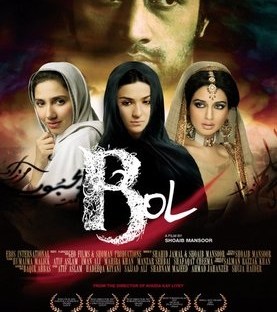
Mr. Khan’s Review on Bol (2011)

A review on Pakistani Drama feature length film, Bol (2011) aka Speak. The Production House is Shoman productions while its Distributors are Geo Films and Eros International Ltd.


+ Crew

  • Directed, Written, Music & Produced by Shoaib Mansoor
  • Cinematography by Salman Razzaq
  • Production Design & Wardrobe by Fatima Jilani
  • Edited by Armughan Hassan
  • Makeup & Hair styling by Ather Shezad


+Note

Bol’s OST by Baqir Abbas while its music contributions by Atif Aslam, Sajjad Ali, Ahmed Jahanzeb and Hadiqa Kiyani. It is a debut film of Mahira Khan.

This film was a critical and commercial success, and became one of the highest-grossing Pakistani films of all time. Bol concerns a religious Muslim family facing financial difficulties caused by too many children and changing times, with a major plot involving the father’s desire to have a son and his rejection of his existing transgender male-assigned-at-birth daughter. The objective of the project was to advocate for women’s rights by bringing the focus of media and the elite of Pakistan to family planning and gender issues.

Bol is set in Lahore and many students from National College of Arts’ (NCA) film making department assisted Shoaib Mansoor on it. It was awarded the best Hindi film award in IRDS Film awards 2011 by the Institute for Research and Documentation in Social Sciences (IRDS), a Lucknow-based civil society organization for raising many social issues including the regressive attitude of a male-dominated society.


+ Main Cast

  1. Humaima Malik as Zainub
  2. Manzar Sehbai as Hakim Sahib
  3. Shafqat Cheema as Ishaq “Saqa” Kanjar
  4. Amr Kashmiri as Saifi
  5. Atif Aslam as Mustafa


xxxxxxx


+ Supportive Cast

  1. Mahira Khan as Ayesha
  2. Zaib Rehman as Suraiya
  3. Iman Ali as Sabina
  4. Irfan Khoosat as Mustafa’s father
  5. Meher Sagar as Young Saifi


+ Plot

A female convict on death row, her last wish is to tell her story to the media.


+ High Points

i – Humaima Malik’s performance is really good in playing as extrovert character. She showed everyone, how well she could play a lead role.

ii – Manzar Sehbai did a terrific job in the role as abusive father and husband. His inclusion in this film Bol made even further interesting to watch. Other Honorable Mentions: Shafqat Cheema and Atif Aslam.

iii – The multiples issues that are shown in the film are important problems that are either too sensitive or taboo to discuss about which are covered by some misguided religious molvis and scholars.

iv – The cinematography is quite effectively shoot, especially the different angle shots that are taken in creative manner of the city of Lahore.

v – Its interesting story made the viewer’s highly motivated to watch it till the end.


+ Low Points

i – Too many issues were highlighted in the film where unable to focus one subject matter strongly nor in detail.

ii – It’s funny to see how easily Ayesha is roaming around, going places with Mustafa… even if she is in burkha, the neighborhood is not stupid or blind to see who is it anyway or why don’t anyone complains to their father of it?


+ Overall

The presence of Shaqat Cheema kicks this interesting movie into faster gear where the audience & critics alike consider Bol as one of the most significant films that have been ever produced by our Pakistani film industry.


Rate: 4.0 out of 5 stars


TV series

Mr. Khan’s Review on Chand Girhan (1991)

A review on Pakistani Classic Drama TV Series, Chand Girhan aka Lunar Eclipse (1991). It’s Production and Distribution is done by STN.


+ Crew

  • Directed by Hyder Imam Rizvi and Tajidar Adil
  • Written by Asghar Nadeem Syed


+ Note
Chand Girhan aired on STN in 1991. In total it consists of 15 episodes. It depicts a true picture of feudalism which has strong roots in Pakistan. The drama shows how promises made and broken and everything is right in political dictionary.

The powerful script by Asghar Nadeem Syed along with the superb performances by the best team of actors ensures engrossing viewing experience for the masses.

It is rare to see TV shooting with actors in early 90’s happening inside the airport of Pakistan.


+ Main Cast

  1. Shafi Mohammad as Shah Sb
  2. Sohail Asghar as Jahanian Shah
  3. Faryal Gohar as Gul Bahar Begum
  4. Ayaz Naik as Nasir
  5. Huma Nawab as Sher Bano
  6. Gulab Chandio as Dil Bahar
  7. N/A as Shireen


xxxxxxx


+ Supportive Cast

  1. Qazi Wajid as Kamal Sb
  2. Abdullah Kadwani as Amjad
  3. Shakeel as Khawar Sb
  4. Sajida Syed as Ms. Khawar
  5. Sheema Kermani as Ameer-ul-Nisa
  6. Tahira Wasti as Khamnam
  7. Mehmood Akhtar as N/A
  8. Latif Kapadia as N/A


+ Plot

Gul Bahar Begum, who even after getting married to Shah Sb; is unable to achieve respect in the eyes of the society because of her bitter past. As for Nasir, he with the help of Shireen and his friend are tracking down the source of human trafficking through their journalism skills and newspaper factory that his father owns.


+ High Points

i – Shafi Mohammad performance was very strong as Shah sb, a respectable feudal lord. The late actor had able to make his appearance and character memorable due to his convincingly acting on-screen.

ii – Gulab Chandio, who played the character of Dil Bahar not only performed very well than expectations but also to be noted that his character was very interestingly written. I thoroughly enjoyed watching his performance.

iii – Here we have strong star power, such as Shafi Mohammad, Faryal Gohar, Huma Nawab, Sohail Asghar, Qazi Wajid, Shakeel, Mehmood Akhtar, Tahira Wasti and Sheema Kermani to attract the viewers’ attention to it.

iv – An important topic is discussed, showed regarding human trafficking and how our corrupt police try to tone its publicity down.

v – The story is good with interesting sub plots, especially of revolving around Dil Bahar.


+ Low Points

i – Sohail Asghar who played Jahanian Shah, his dialogues and performance were so-so. Although, his character is quite memorable.

ii – There were some illogical and unrealistic things that they had shown. Examples: Never they showed an actual factory or workers or editorial team of the newspaper factory but only Kamal Sb’s room who is the owner. Similarly, Shah sb is a well-known and respected feudal lord but still anyone can enter his home regardless of having several security guards at his residence.

iii – The chemistry between Nasir and Shar Bano was so dull to watch. Instead, really enjoyed watching Nasir and Shireen together; Nasir was not only colleague to her but she had secret admiration for him.


+ Overall
Chand Girhan may be most watchable TV drama of its time, but it was not as interesting as it should be with such a dynamite star cast and powerful story.


Rate: 2.75 out of 5 stars


TV series

Mr. Khan’s Review on Diyar-e-Dil (2015)

A review on Pakistani Drama TV Series, Diyar-e-Dil (2015) aka The Valley of the Heart. Its Production House is MD Productions while its Distributors are Hum Network Limited and MD Productions.


+ Crew

  • Directed by Haseeb Hassan
  • Written by Farhat Ishtiaq
  • Director of Photography by Zeb Rao
  • Theme Composed by Bilal Allah Dita & Shani Arshad
  • Created & Produced by Momina Duraid


+ Note
Diyar-e-Dil aired on Hum TV from 17th Mar 2015 – 27th Oct 2015. In total it consists of 33 episodes. It is based on the same name novel ‘Dayar-e-Dil’ by Farhat Ishtiaq. The Editing is done by Mehmood Ali Areeb. Its Opening Song “Yar-e-Man” is sang by Zebunnisa Bangash and Ending Song “Goyanke Ishq” by Momin Durani.

The locations for shoot are Skardu; Gilgit–Baltistan and Lahore; Punjab. This TV series follows the lives of a dysfunctional family led by Agha Jaan and his grandchildren, Wali and Farah. It concludes moral lessons regarding respect, love and care in relationships.

Diyar-e-Dil has received critical acclaim and won 12 awards at 4th Hum Awards the most for the ceremony including, Best Drama Serial – Jury and Best Drama Serial – Popular for Momina Duraid, Best Director Drama Serial for Haseeb Hassan, Best Actress – Popular for Maya Ali, Best Actor – Jury for Meekal Zulfiqar, Best Actor – Popular for Osman Khalid Butt, Best Writer Drama Serial for Farhat Ishtiaq and Best Original Soundtrack for Shani Arshad. At 15th Lux Style Awards, it won 2 awards including Best TV Play and Best Original Soundtrack for Duraid and was nominated for Best TV Actor, Best TV Actress, Best TV Writer, and Best TV Director.

There may be SPOILERS ahead!


+ Main Cast

  1. Abid Ali as Bakhtiyar Khan/ Agha Jan
  2. Mikaal Zulfiqar as Behroze Bakhtiyar Khan
  3. Ali Rehman Khan as Suhaib Bakhtiyar Khan
  4. Sanam Saeed as Ruhina Behroze Khan
  5. Hareem Farooq as Arjumand Suhaib Khan
  6. Osman Khalid Butt as Wali Suhaib Khan
  7. Maya Ali as Faarah Wali Khan


xxxxxxx


+ Supportive Cast

  1. Ahmad Zeb as Moeiz Tajamul
  2. Behroze Sabzwari as Tajamul Arsalan
  3. Maryam Nafees as Zarminey Suhaib Khan
  4. Tara Mahmood as Zuhra Tajamul
  5. Eshita Mehboob as Laila Feroze Khan
  6. Rasheed Naz as Bedar Khan
  7. Azra Mansoor as Yasmeen Bedar Khan


+ Plot

It follows from where the disturbance occurs in the lives of Agha Jaan’s wealthy tribal joint family due to their eldest son, Behroze’s decision of marrying elsewhere.


+ High Points

i – This is best performance I have watched up till now of Mikaal Zulfiqar, who acted splendidly as Behroze Bakhtiyar Khan.

ii – Sanam Saeed as Ruhina shown as mean, cold heart old woman who has gained a great dislike and hatred for her husband’s family / her in-laws after disowning them for their will. It is always a welcome to have her on-board.

iii – The performance given by Maya Ali as blunt mouth, out spoken, immature, confused girl ‘Farah’ is worthy to watch and has able to regain her status as good actress. Her previous performance I have watched was in ‘Mann Mayal’ (2016) which then made me seriously to avoid watching any of her projects for a long time until now. Other Honorable Mentions: Abid Ali, Ali Rehman Khan, Ahmed Zeb, Behroze Sabzwari, Hareem Farooq and Osman Khalid Butt.

iv – The story’s opening and its ending is strongly written. A solid opening gives a good impression while a decent ending gives an everlasting reputable impression. This has worked well with many different media adaptations and projects alike. One of the most popular current examples can be given of the Hollywood comic film ‘The Dark Knight Rises’ (2012).

v – The last three episodes are dedicated to a proper, detailed ending. It is rare to see this in TV series or films even. Here the writer and director made a well-earned decision and stick by it to have a respectable, memorable finale.

vi – The direction of this TV series is praise worthy. This is the first project I have watched of Haseeb Hassan and it is safe to say that it is a very decent work. Good job!

vii – The performances by the entire cast is superb. The real credit goes to the director, Haseeb Hassan as it is his responsibility to make sure to get realism from his cast members according to their respected characters and how the script demands it to be.

viii – The strong emotional link which was established in the start between the main characters and the viewers was really heart touching. The deaths of main characters made the viewers’ feel for their great loss and have gained emphatic link for them.

ix – The production design has given noble efforts to fulfill it in most decent manner. This can be seen in its entire series.


+ Low Points

i – The body of the story is very weak especially keeping it in the view that this is total 33 episodes drama series. In the start, the strong interest level lasts till 14 – 15  episodes while the interest level is gained back to the viewers in the last five episodes (i.e. from 29th – 33rd).

In the mid of the episodes, the writer has stretched this drama as long as possible with similar repeated story issues of getting emotional black mailed, Aga Jan’s heart conditions, Moeiz & Wali’s feud and believing every love support is a lie. The interest level of the mid story starts to deteriorate just like slow poisoning. I literally thought it may eventually end up similar to the in-fame TV drama series ‘Mann Mayal’ (2016) but thank God it does not. If it wasn’t for the review, I may have gave up watching in the mid of the episodes.

ii – The logic of the drama is that if a female character is wearing ‘Hair Band’ then she is childish while if the same character stops wearing it the next day, has now become a mature person.

Likewise, they play comic score only when they want their viewers not to take us serious in their particular scenes / moments. Mind you that there is no comic relief character in this drama series.

There are many examples including when Wali finds Moeiz & Farah having dinner behind his back and catches Moeiz proposing to Farah for engagement, Wali confronts them. At that same scene, the comic score is played when the jealousy is shown between the two guys while in the same scene a serious score is suddenly played when Wali makes Farah realizes that she is still his wife and if wanted, can force her to go with him to his home town. WTF?

And I would never dine in those restaurants if I find them completely empty while having waiters only.

iii – If the family is living from generations to generations at Gilgit-Baltistan area then why does their accent is in Urdu for? Only in some minor scenes in the start we are shown that the same characters are now speaking their origin accent.

iv – I believe that the negativity of Moeiz’s nature should have been kept hidden till when he faces Ruhi and exposes his true intentions then & there. It would have been a good twist but it is the writer’s / director’s call in the end.

v – I don’t understand that if this TV series is good budgeted and has an experienced crew working on it then why its visual effects are equivalent to the ranks of a student’s film? Example: In the starting of the episodes, it clearly shows that the cast is standing in front of a green screen where their surroundings is artificial and when the main characters are looking at the pictures on the wall are not actual photographs but visually inserted there to look as they are real photos.

vi – After Arjumand’s refusal to Ruhi on the marriage proposal for their children, Arjumand realizes later on that Farah is really innocent and convinces her son of it too. But they never care to show how and when Arjumand has made her peaceful ties with Ruhi again but that everyone is now living happily together as joint family.


+ Overall
Diyar-e-Dil is a close adaptation of the novel by Farhat Ishtiaq, good performance with emotional bond have made the viewers’ fall in love with the characters instantly. Though, it is burdened with absence of ideas on how to progress the story while preserving the interest level till its end and the supposedly fainting love triangle among Farah and her beaus which lacked serious interactions that could produce good chemistry.


Rate: 3.25 out of 5 stars


Feature Length Films

Mr. Khan’s Review on Raasta (2017)

A review on Pakistani Action-Drama feature length film, Raasta (2017) aka Path. The Production Houses are Sahir Lodhi Films, Hom Production, Sams Company & TV-1 Films while it’s Distributor is IMGC Global Entertainment.


+ Crew

  • Written, Narrated, Produced & Directed by Sahir Lodhi
  • Cinematography by Nabeel Jawaid Qureshi
  • Co-Written by Shahid Naqvi
  • Edited by Muhammad Irfan & Muhammad Bilal Habib
  • Co-Produced by Moid Ul Hassan and Dr. Faisal Zia


+ Songs

  1. Rahat Fateh Ali Khan
  2. Sara Raza Khan
  3. Nabeel Shaukat
  4. Damiya Farooqui
  5. Saman Saleem Sabri


+ Note

Raasta was to be released on 23rd March 2017 (Defense Day). However, due to getting heavy censored it was postponed and released on 31st March 2017. Since the film is cut a lot before its release thus it is unjust to blame on film editing as many times I felt why this scene was shown after this one. To do justice, one needs to watch the original cut (uncensored one). But the question is who has the guts to do that?

The music directors are Sajai Ali & Kamran Akhtar. It’s about two brothers, Sultan who is the elder brother, police inspector and has a family. The younger brother is Samir, who is qualified but is unemployed for last 8 years. This is Sahir Lodhi & Saima Azhar’s debut film.

Raasta’s theme reminded me of fame Bollywood film ‘Vaastav’ (1999).


+ Main Cast

  1. Sahir Lodhi as Sameer
  2. Aijaz Aslam as Inspector Sultan
  3. Syed Naveed Raza as Sherry
  4. Shamoon Abbasi as Shah Nawaz Rajput
  5. Sana Nawaz as Bhabhi
  6. Abeer Rizvi as N/A
  7. Saima Azhar as N/A
  8. Saleem Mairaj as N/A
  9. Mathira (Item Girl) as N/A
  10. Saniya Mansoor as N/A


+ Plot

The bond of two brothers is shown where the elder one Sultan is an honest police inspector, has a family and firmly believes that no one should be considered above the law. As for Samir, who is unable to get a white collar job thus starts doing odd jobs to make his ends meet. During Samir’s struggle for good work, he gets mixed up with gangsters like Shah Nawaz and his younger brother Sherry.


+ High Points

i – Aijaz Aslam’s acting is above average whereas mild performances by rest of the cast including Sahir Lodhi’s (but in the first half only).

ii – I liked the film’s message which they conveyed it throughout their film ‘Raasta’ (Path) that is instead of choosing between a righteous or misguided path to reach to your destiny… here the lead character is forced to take wrong path as a result of being jobless, society ignorance, lack of family support and getting into brawl with wrong people.

iii – The struggle to choose righteous path while facing many hurdles was properly handled in the film. The director gave importance in establishing his character emotional link with the audience. I believe it was a good effort that made in making the connection. What I am saying is that the first half of the film is… watchable! There, I said it aloud.

iv – The makeover of Sahir Lodhi in second half while the makeup & hair styling of Mathira looks good.

v – The cinematic shots and lighting particularly in the songs are nicely executed.

vi – Most of the songs are nice to listen to. Not all but most of them.

vii – Art direction throughout the film is very decent.

vii – There is a shot taken in the later of the film where Sahir Lodhi is lying down in the similar position of crucifixion. Either this scene was intended to give symbolic meaning to it or maybe Sahir Lodhi thought it may look cool on-screen.


+ Low Points

i – Writing is a very difficult task indeed. Anyone who has worked in the media production would agree to this right away. For a good writing skill, one should be able to give proper portray of their characters, to do justice with them, a story worth telling, sharing with the people — which is not an easy thing to do. It needs a lot of experience, study how to write or work under the guidance of an expert.

However, when a person who has vast abundance of wealth, many references / contacts then that person would most probably not give any heed to this above say and would a make film like ‘Raasta’. Although the film’s plot may look good on paper, but once it is shown as a film especially after interval — its equivalent of having brain hemorrhage.

ii – Sahir Lodhi’s character from start of the film shown able to overcome any thug, always wins in fights against anyone, even if that person is mafia leader / don himself. After the interval, all hell breaks loose! Then Sahir Lodhi’s character becomes very similar to Greek mythology’s immortal demi-god. Now anything is possible by him.

iii – Saleem Meeraj is such a good actor. He is usually in such good projects. But what made him say yes to be in a film like this? Anyone? I think perhaps to maintain his friendship he had to be in the film.

iv – We don’t have just one but two item songs. Yes, two! It does not matter if the item song is performed by a respected model / actress or not, either way it is still degrading and offending to be inserted in the film. Item girls are always considered as sex objects for the viewers and speaking of item songs, why do we need them anyways? Can you not entertain people with your good script, strong performances and great direction? In this case, no it’s not possible.

v – After a cliffhanger interval which was misleading (naturally), all logic is now officially thrown in the trash can and the film dares you to watch whatever they show you on screen. At this point, I was thinking perhaps watching Waseem Hassan Sheikh’s notorious ads were a better option.

The things they have showed in the second half is cruelty to your brain; because as soon as the interval came, it give you one last final warning to pack your bags and move abroad or just ditch your film ticket’s expense and go have a dinner at a good restaurant. As your life is more precious than what you are about to witness after the interval.

vi – When a person kills your loved one, it is understood that you would come back with vengeance (especially when both are killers). So instead of gathering your forces and keeping them on high alert, that person is enjoying an item song while having alcohol and getting wasted.

vii – Samir’s transformation into new self can now shoot & kill anyone without even looking. No matter where ever that person is, he just shoots them dead. All this is done with one magazine only which is enough for him to tackle and kill the entire gang of mafia rivals (clap, clap, clap… Bravo!).

viii – The fight sequence between Shamoon Abbasi and Sahir Lodhi is not only unrealistic but that the wiring attached to Shamoon is making him jump in highly impractical manner.

ix – A woman comes complaining to Shamoon Abbasi to know the whereabouts of her missing husband to which he lets her know but forces her to live with him instead. And in the very next scene, we are shown that woman has become his mistress… willingly! What…? My! I guess he must be so good in bed huh? <Wink>

x – A punch line Shahrukh Lodhi kept repeating in the film … ‘Is Zindagi Meh Sirf Do Log Hothay Hai… Eik Tum Aur Eik Meh’. And you have to listen to this lame dialogue in last few scenes much often.

xi – What we are shown in its end, is highly unlikely thing to happen. It is shown as a dream sequence but I can assure you that it’s not!


+ Overall

Despite the apparent great cinematography, decent songs, sound performances yet Raasta is a highly fictionalized story of one-man battle with never-ending trash action sequences and cheesy dialogues.


Rate: 1.75 out of 5 stars


Feature Length Films

Mr. Khan’s Review on Chain Aye Na (2017)

A review on Pakistani Romantic feature length film, Chain Aye Na aka State of Restlessness (2017). The Production House is Hollywood Impressions & Paragon Entertainment Combined Production.


+ Crew

  • Written, Directed & Produced by Syed Noor
  • Cinematography by Irfan Mirza
  • Edited by Syed Umar Shafiq
  • Music by M. Arshad & Iffi-K (UK)
  • Co-Produced by Jawed Siddiqi and Naim Haroon Sakhia


+ Note

Chain Aye Na’s infamous trailer created such a viral just within couple of days where many people and fans alike questioned Shehroz Sabzwari’s move to choose such a film. The film itself received mixed to mostly negative reviews by critics.

Adil Murad is the son of late Waheed Murad, one of the most famous Pakistani film actors of all time. This film debuts actress Sarish Khan.


+ Main Cast

  1. Shehroz Sabzwari as Rayyan
  2. Sarish Khan as Ruba
  3. Adil Murad as Murad
  4. Sobia Khan as Murad’s Mistress
  5. Mustafa Qureshi as Murad’s Father
  6. Nadeem Baig as Ruba’s Dad


xxxxxxx


+ Supportive Cast

  1. Behroze Sabzwari as Rayyan’s Dad
  2. Danish Nawaz as Danish
  3. Atiqa Odho as Ruba’s Mom
  4. Waqar Godhra as Rayyan’s Friend
  5. Maryam as Rayyan’s Friend-Sis


+ Plot

It revolves around Rayyan, who is a young musician and falls in love with Ruba at first sight. However Ruba has no interest in Rayyan as she thinks she is happily engaged to Murad.


+ High Points

i – Danish Nawaz as Rayyan’s friend and musician has performed well. I was actually enjoying in watching his scenes. Other Honorable Mentions: Behroze Sabzwari and Mustafa Qureshi.

ii – The comic relief by Danish Nawaz and occasionally by Mustafa Qureshi was hilarious. They add up much fun during this un-interesting film.

iii – Most of the songs are good to listen to only.

iv – Shehroz Sabzwari’s boyish looks and attitude finally matched his role perfectly well. A person with a case of highly immaturity and is madly in love with to-be soon married young female.


+ Low Points

i – Warning: After watching Chain Aye Na personally, since there is a long list of flaws in this film that is why it’s better to talk on only the most recognizable ones.

A romantic comedy film turned out to be just cheesy-comedy film unintentionally. Just as the interval came, a guy sitting in front row to me said it a loud “Oh-My-God”! And everyone started laughing. Everyone means 11 people. That’s the total number of people as audience at Nuplex cinema hall; although this film is released only few days ago. Then we see that Rayyan is unable to take ‘No!’ for an answer. The same guy sitting in front row of mine said ‘Is he mad?’ Just like before, everyone started laughing. Even in dance scenes, audience were chuckling and giggling while covering their mouths.

ii – I disagree with other reviews regarding showing domestic violence against women. The film’s message was not that at all. Instead it shows no matter what, if a guy truly falls in love with someone and believes in himself then no one or divine intervention can stop him from winning that female’s heart. She would definitely fall in love with him eventually once she realizes his true love and craziness for her. Although I remember a very good Bollywood film, depicting same issue where the things end up pretty opposite as they would in real life — That film’s name is ‘Darr’ (1993).

The other message was how some parents take their children for granted and uses them for achieving their personal goals.

iii – This film needs a good dance choreographer, as Sobia Khan decides to wear red dress tries to dance in seductive manner but it appears as if she is aerobics fanatic.

iv – It gives a very bad impression of Shehroz Sabzwari to see with his father always / mostly in his projects. It looks as if Shehroz cannot find work and looks up to his father Behroze Sabzwari all the time. His father should let his son make his own choices regarding film career at least and try to work in separate projects. Let Shehroz appear in good films for some time before start working in his projects again. Shehroz has a long way to go to be in his father’s footsteps.

v – Adil Murad plays a dark, bad character therefore there are hardly any lights in his ‘Castle Vania’ where he most of time is in his nighty, smokes cigars and drinks a lot. His favorite place for ‘Having fun’ is by the house / farm’s poolside with his lovesick mistress.

vi – In different vocal songs, Shehroz’s voice doesn’t matches at all. It clearly shows that he is lip sync only.

vii – The intense scene in the film’s end was so funny that no one in the audience had a straight face but kept laughing non-stop. The sound of laughter became so loud that it started echoing in almost empty hall.

viii – Adil Murad’s last scene indicates that most probably there would a sequel. — A sequel?!? Are you ****ing kidding me?? Whose goanna watch THAT?

ix – Rayyan and Ruba come running to hug each other with such an expression on their faces which shows clear sign of relief as almost saying it aloud ‘Thank God! the film is over’!


+ Overall

Chain Aye Na is so Bad that it’s actually ‘Good’ and may become cult favorite by Syed Noor’s die-hard fans.


Rate: 1.0 out of 5 stars


Theatre Plays

Mr. Khan’s Review on Khawab Tha Shayad (2018)

A review on Pakistani Drama theatre play, Khawab Tha Shayad (2018). It was performed at NAPA basement.


+ Crew

  • Costume Design, Production Design & Directed by Irfan Khan
  • Written by Fawad Khan
  • Lights by Masood ur Rehman
  • Sound Mixing by Sunil Shankar
  • Produced by IB Productions


+ Note

Khawab Tha Shayad is directorial debut by Irfan Khan. Raheel Siddiqui and Najma Kifayat played the lovers’ movement while Fawad, Affan and Marium were as Extras.


+ Main Cast

  1. Yogeshwar Karera as Salman
  2. Areeba Aqeel Burney as Saba #1
  3. Irfan Khan as Salman (Young)
  4. Ifrah Khalid as Saba (Young)
  5. Naz as Salman’s Mother
  6. Aamir Naqvi as Salman’s Father
  7. Sehrish Qadir as Saba #2


+ Plot

A young couple, Salman & Saba fall in love with each other. To fulfill their dreams and have complete freedom, they decide to move in together away from their families. But once having their new home, everything starts falling apart.


+ High Points
i – After such a long time, able to see Irfan Khan perform in a lead role as immature, insecure, young lover Salman. His strong performance had the audience fall in love with him who was new to watch his acting. As for me, he made me very pleased on the growth as a performer. Well done!

ii – The playwright is interestingly written, something to be proud of. Always loved Fawad Khan’s scripts.

iii – Wow! I am … impressed by Ifrah Khalid who played the role of Saba as another immature, hot headed, straight forward lover. With her firm acting skills it possible to see her as the new limelight of the theatre world and TV, film industry. Other Honorable Mentions: Areeba Burney and Yogeshwar Karera.

iv – Irfan’s direction as a first timer for this tragic play was good. It helped to make the scenes more interesting to watch.

v – The humor level was light and reasonable for the play’s content.


+ Low Points
i – I am sure that we can easily skip cheap dance performances which were not only unnecessarily shown but also had a Titanic tune with it.

ii – Type Caste roles are an abomination to our media industry. The places such as NAPA, Arts Council should give chances to their students to perform in a different role, so they be able to learn and see for themselves that they can act in any role given to them brilliantly without making them a type caste performer. This is already happening in our media industry for decades and should be reduced from these schools for the betterment of these future artists.

iii – There was no need of movement performance, I can assure you. It was completely pointless.

iv – The production design was dull, very boring. There were hardly any props given importance to.

v – Really, I have no issue on watching a play based on a simple story. What really counts is its presentation and how well it is directed. However, since the director himself is a newcomer, therefore the overall picture gave an overused plot.

vi – I must say that the team behind this play’s management handled it very poorly. There should be a restricted age requirement on who can attend plays with strong languages, themes it based on. By maintaining a calm, peaceful environment, punctuality, time barrier for the audience to watch the play with ease and in relax mode… rather than half of the attention is subconsciously focused on crying kid whose parents gave no heed to make it quiet or take the kid outside to stop from creating any further disturbance.

vii – With a simple story, we also have a very predictable end. Unlike to a very intriguing story written previously by Fawad Khan, this time we have a very common story to deal with.

 
+ Overall
Khawab Tha Shayad is an interestingly written playwright along with strong lead performances. But it is also a victim of its own suffering through a series of errors.

 
Rate: 2.25 out of 5 stars


Theatre Plays

Mr. Khan’s Review on Heer Ranjha (2017)

A review on Pakistan Romantic Drama theatre play, Heer Ranjha (2017). It was performed at Arts Council Karachi.


+ Crew
I. Directed, Production Design, Costumes Design & Written (Adaptation) by Naz

II. Asst. Directed by Damyanti Gosai

III. Co-Written (Adaptation) By Kafi Kazmi

IV. Vocal Song by Anil Tahir Azad


+ Note
Heer Ranjha was originally written by Waris Shah. Some historians say that the story was written after Shah had fallen in love with a girl named Bhag Bhari while other people say that Heer & Ranjha were real personalities who lived under the Lodi dynasty. Later on, Waris Shah later utilized these personalities for his story.

It’s possible that this story has symbolic meaning attached to it, referring to the implacable chase of a man has towards his creator.

Heer Ranjha is one of the most popular tragic romances of Punjab which it is about the love of Heer and Ranjha. Due to its plot and tragic story, it is often compared to the Shakespeare’s play ‘Romeo and Juliet’.


+ Full Cast
1) Fajir Sheikh as Heer

2) Umair Rafiq as Ranjha

3) Samhan Ghazi as Qazi (Molvi)

4) Aamir Naqvi as Sarpanj

5) Muntazir Mehdi as Seida (Dumb)

6) Damyanti Gosai as Sehti / Heer’s Mother

7) Asma Noor as Village Girl #1 / Heer’s Friend #1

8) Roohi Ahmed as Village Girl #2 / Heer’s Friend #2

9) Saddam Hussain as Qeedu (Handicap)

10) Aisha Iqbal as Ranjha’s Bhabhi

11) Akbar Aftab Ladhani as Ravi (Narrator)

12) Anil Tahir Azad as Waris Shah (Singer)

13) Ashfaq Ahmed as Chaudhry (Heer’s Father)

14) Raheel Siddiqui as Ranjha’s Brother

15) Zain Qureshi as Groom’s side Dancer #1 / Daako #1

16) Zeerak Khan Niazi as Groom’s side Dancer #2 / Daako #2

17) N/A as Heer’s Groom


+ Plot
Heer is a beautiful girl who is born in a wealthy family of the Sial (tribe) Jatt while Ranjha also a Jatt of the Ranjha tribe and is the youngest of four brothers who lives in the village of Takht Hazara. One day in wedding ceremony, Ranjha meets and falls in love with Heer. Unfortunately there are those people full of envy who would do anything to stop this from ever happening.


+ High Points
i – Saddam Hussain as Qeedu is yet again, the show stealing performance. It seems that he was born to play the role of Qeedu. His strong performance was one of the reasons why the interest level was kept throughout the play.

ii – Roohi Ahmed has done a fantastic job in playing her supporting role. She performed her character with such ease and was enjoying herself. Other Honorable Mentions: Umair Rafiq and Aamir Naqvi.

iii – Lots of improvement in the character development especially of the main characters which made an important connection with the audience. Then whatever conflicts would fall on these two lead actors, we as audience would feel their pain of hurting or losing them.
iv – Not sure to see Ranjha taking off his ‘fake’ beard was part of the script or added to make it as amusing scene. Either way, it was worked with the moment.

v – Good development with the narration by Akbar Aftab Ladhani. He was able to capture the tragic moments with his strong vocal and eye contact. Nice work!

vi – Nice vocal songs sung by Anil Tahir Azad. It helped to move the story forward and gave emotional touch to it.


+ Low Points 
i – Due to lack of experience, the lead performances were average at best but not great. The fault is not of these two lead actors as they are still in their young acting age. The casting of the lovers should be given to those actors who would deliver strong performances as the script demands.

ii – Lighting should further be improved. Such as the first time when Ranjha looks at Heer, there should be two lime lights only where one at Ranjha and other one at Heer while all other lights should be switched off or lit very dimly.

iii – Although Fajir Sheikh did a fair job as Heer but she needs to work with her voice control and how to speak in playing different characters.

iv – The set design was okay but it covered major of the stage portions. The actors were restricted with very limited movement / blocking.


+ Overall
This remake’s several scenes were improvised, many of the interesting dialogues were added to boost up the morale and the hard work of the performers in making Heer Ranjha an enjoyable play.


Rate: 3.25 out of 5 stars