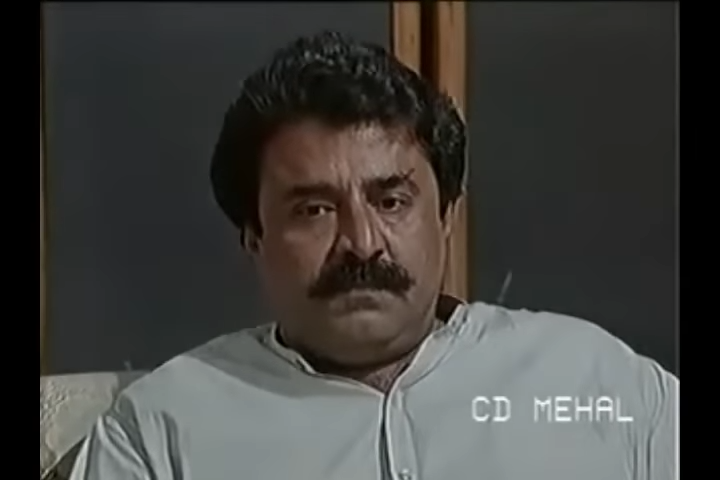
A review on Pakistani drama TV series, Aanch (1993). The 13 Episode limited TV series is directed by Tariq Jameel and is a PTV Karachi Center production. In 1993, Aanch was broadcasted nationwide on Pakistan Television.
+ Crew
- Directed by Tariq Jameel
- Written by Naheed Sultana Akhtar
- DOP by Abdul Majib
- Produced by PTV Karachi Center
+ Note
Aanch is a TV drama which focuses on social issues like divorce and remarriage. It asked vital questions such as “How is a woman viewed by our society if she files for a divorce from her husband?” and “How are children from a previous marriage supposed to be taken care of under such circumstances?”. For its time, Aanch touched upon a subject matter which was widely regarded as taboo from being screened on commercial television. The drama is based on a novel ‘Behtay Paani Pe Makan’ by Naheed Sultana Akhtar who also acted as the writer to the TV adaptation of it. Aanch is a showcase of patience, perseverance and in the end, triumph of love.
+ Main Cast
- Shafi Muhammad Shah as Jalees
- Shagufta Ejaz as Khulfat
- Sami Saani
- Mehak Ali
- Shehla Solangi
- Ayesha Khan
- Mehmood Ali
- Qaisar Naqvi
- Farheen Nafees
- Kunwar Nafees
+ Plot
Jalees (Shafi Muhammad) is wealthy businessman who’s wife Asma recently left him and their three children to grasp the opportunity of living abroad. Worried about his children growing up without a mother, Jaless decides to remarry to a working girl named Khulfat (Shagufta Ejaz). Unfortunately things do not go as planned as the step mother and the children have a hard time accepting each other.
+ High Points
i – Aanch is a drama that just gets better with time. Not just episodically but also with the decades that have passed by. Released back in 1993, marriage and divorce were such bold subjects to explore on prime time television. It is somewhat unimaginable how this drama stood out from the rest of the shows on television at the time. And since Naheed Sultana Akhtar also serves as the writer and adapted the screenplay for television, one could just feel how personal the subject matter was to her. I think having a female writer really helped portray a “feminine” perspective to the show. Divorce has a much stronger connotation on a woman than a man and this fact has been on full display and explored on this show. Aanch steps out of the drama world and portrays a more realistic view of how characters would have adjusted in such emotional turmoil. As the name suggests, Aanch has a double meaning in Urdu. One is “feelings of great warmth and intensity” and other “an open flame”. Both when implemented, can easily ignite a happy family within a matter of seconds. And this is what the show represents.
ii – The writing of the show is superb. The emotions and motivations are brilliantly conveyed through spoken dialogues, none of the lines feel forced or out of character. It is, at times, not easy to translate written dialogue to spoken. Sometimes what sounds good on paper does not translate well spoken but Naheed Sultana Akhtar has done an outstanding job in bringing life to her novel onto the small screen. A lot of credit should go to her writing skills for the success of this classic PTV drama.
iii – It probably goes without saying that Shafi Muhammad Shah and Shagufta Ejaz are simply enigmatic whenever they share a scene together. Even with a tightly written script, I personally felt that (at times), the dialogue was improvised between the actors to bring some further “humanity” into the given predicament. Their characters were so utterly convincing at times that as a viewer, it was hard for me to separate the characters from the actors. On one hand, we see the struggle Jalees (Shafi Muhammad) goes through in order to provide his children with a stable upbringing while on the other hand, one could also sympathise with Khulfat (Shagufta Ejaz), who was somewhat forced into this marriage by her family, with children that she has no connection with, the offsprings who just plain refuse to accept her as their new mother. Through their brilliant performances, Shafi Muhammad and Shagufta Ejaz make the conflict clear for the audience to follow and empathise with both sides at the same time. And that is not a small feat to accomplish.
Also I do have to admit that the School of Acting that Rahat Kazmi or Shafi Muhammad Shah came from is unfortunately a lost Art now. Taking nothing away from the actors of today, there was a particular sense of “humanity” that was present in such performances that make these classic dramas so entertaining to revisit time and time again.
iv – Also the supporting cast plays a vital role to the success of the show, particularly Mehmood Ali. His performance really permeates throughout the show as the “voice of reason”. His performance had to be good in order for the show to work and he made every second of the show count.
v– Even the “B story” of the show was interesting and well intertwined with the overall narrative of the show. This is a problem that many episodic TV shows face to balance but Aanch is a textbook example of how it should be handled.
vi– Only 13 Episodes long! A lot of shows have a given quota to prolong the show but Aanch knew the limits of how far the story should be stretched and as a result, the narrative feels tight, responsive and no scene or episode feels dragged or out of place (with exception to one in particular). A lesson MANY television shows of today can learn from.
+ Low Points
i – Although the subject matter and the performances are arguably ahead of its time, the production of the show (unfortunately) is not. Yes, as a reviewer, I should be more forgiving for the TV shows produced in the 90s but some odd production choices did (at times) ruin a dramatic scene which sadly just came off a tad bit comical. Take for example the first episode, there is an intense dramatic scene where Jalees’ first wife is having an argument with him, Jalees blurts out “SHUT UP!”, followed by an exploding (?) building with intense lightning??? Honestly, I just had to laugh at that. Thankfully, this technique was never repeated in the latter episodes. But it is what it is. A product of its time. The camerawork is uninspired, sound is at times muddled, the budget (and the skills behind the camera) were probably not much to brag about. So if you plan on revisiting Aanch (which I wholeheartedly recommend), watch it with an open mind.
ii – The child actors were not particularly good. I’m sure Kunwar Nafees tried his best with what was given to him but none of them felt convincing to the immediate narrative of the show. When you compare their performance to shows like Ankahi (1982) and Faisal Bilal as Jibran, his performance was leaps and bounds ahead. Whenever the scene with child actors came on, I felt being taken out of the show a bit. Unfortunately the director Tariq Jameel is also at fault for not bringing out the best performances from his young actors.
iii – The dialogue is too intermingled with English. On the surface level, I realise that is an odd criticism to make since normally, Pakistanis mix the two languages (Urdu/ English) a lot but sometimes, what works in the real world doesn’t necessarily work on the Television screen. The constant switching of languages (especially by the child actors) was very distracting. A few English words sprinkled in between Urdu sentences is not an issue at all but complete English sentences during Urdu dialogues was very jarring for me as a viewer.
iv – The final episode was basically a clip show from all the previous episodes. Even though I praised the show for being concise with its number of episodes, the clip show just felt like either they ran out of story to tell or they didn’t want to spend money so the creative team decided to rerun their past scenes in between. Either way, the final episode can largely be skipped.
v – SPOILER ALERT!!! (In the next point, I will talk about the ending of the show. You can skip directly to Overall if you would like to avoid it):
For the most part, Aanch has a great balance between the two opposing sides but as the show progresses, the sympathies eagerly lean more towards the husband’s side of the story. In my opinion, both sides were at fault, why did Khulfat have to be the only one to apologize? Just because her husband gave a favorable testimony for her in court, doesn’t automatically clear him off his own mistakes.
Khulfaat was also mistreated by her step children, threatened and verbally abused and the husband did particularly nothing about it. I felt he also needed to step up and apologize for his mistakes of not handling his children well. As the conclusion of the show goes, the idea of the woman not appreciating what she had is prominent much more than the husband who was also at fault.
This conclusion is not bad by any means but it could rub the modern viewers the wrong way and some could even take the wrong “lesson” out of this story.
+ Overall
With such a bold and interesting subject matter to explore, Aanch is a show that was well and truly ahead of its time. Whenever people talk about the “golden days of Pakistani Television”, Aanch is definitely one of the shows that comes to my mind.
Rate: 3.75 out of 5 stars




 out of 5 stars
 Mr. Khan's Reviews